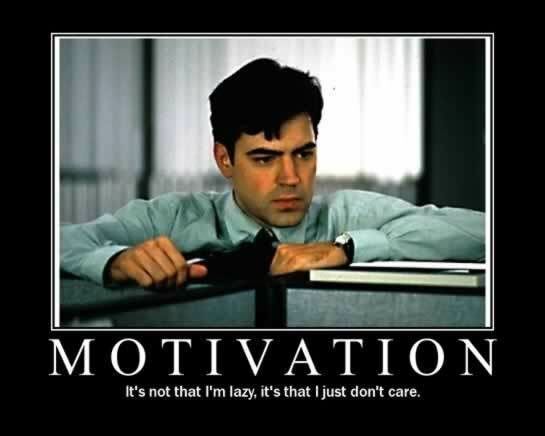
Tampilkan postingan dengan label motivation. Tampilkan semua postingan

Kamis, 22 Juli 2010

Employee motivation

Source : Motivation123


The #1 Motivation Mistake
Managers around the world are committing a fatal error that is depriving their people and companies of improvement, progress, and success. While very few know of the dilemma, its solution is the most important and powerful principle that any coach or manager will ever learn.

Imagine stepping into an enormous kitchen overflowing with uncooked meals and desserts. All of the necessary ingredients for a countless assortment of dinners are there - you simply have to prepare them.

Now imagine preparing and cooking them in identically the same way. It doesn't matter what meal you are dealing with - you follow one set of instructions without fail.

Perhaps your favorite meal is a thick and juicy hamburger. If you're actually preparing and cooking a hamburger, you're right on track. But what if you're dealing with ice cream sandwiches. How well do you think throwing some ice cream onto a grill would work? Trying to flip it so both side get evenly cooked?


The Greatest Management Mistake
Preparing and cooking ice cream in the same manner as a hamburger would obviously result in failure. You can't treat all ingredients and meals as the same thing - they are all different, requiring different methods and techniques to achieve their particular result.

The greatest management mistake should be painfully clear: many managers treat all employees as the same assortment of ingredients trying to motivate them toward greater success using one cookie-cutter approach.

Just as failure results from throwing ice cream on a grill, so too will a manager fail in inspiring his people if he attempts to do so using a single method.

The people on your team are as different as baked beans and apple pie. They each work from a unique set of motivators, responding to some with excited action and others with boredom or even anger.

It's up to you to discover what drives each one of your team members. What elements excite them? What elements turn them off? It may take a little time and concerted effort on your part, but uncovering the powerful motivators that drive your people will be the best thing you can do for you and your team.

Remember, you may respond to financial rewards or incentives, but that doesn't mean everyone on your team will share your sentiments. Listen to your people. Recognize and utilize their motivators. You are dealing with a wide assortment of ingredients, and following this principle will allow you to prepare each one with amazing success.

Job Info , Jobs , Career

Bookmark and Share

The Real Killer of Motivation

Routine is a murderer.


Years ago, before starting the Motivation123 Web site, I had pockets full of plans and ideas. My mind was in a constant state of activity.

As for my reality, nothing ever changed. Nothing in my life went in the directions I had hoped for. It got to the point that I began to doubt whether or not a better life was even possible. Could I change?

Then, while paging through a magazine at the doctor's office, I came across a question, just a short team of words that gripped my attention.

It was simple--as most powerful truths are--but it made an immediate impact. And from that day I possessed a key to progress that has served me ever since.

Before we get to that answer, however, we need to pin down the problem.


The Killer
In a word, it's routine.

It's the pattern of living that, like molten lava, slowly crawls into adulthood, covering and consuming our hopes, dreams, and ambitions.

It's doing the same thing every day because that's what you've always done. It's a vicious circle of repeating actions and events that leads to nowhere.

The reason nothing was changing in my life was because I was stuck in a routine. Every day I followed the same basic outline of living: wake, work, sleep, repeat.

I had new ideas, to be sure, but my actions were old.

Then I was hit with the truth while waiting - for what seemed like weeks - in my doctor's waiting room.


The Question I Took with Me
The sad reality is that most people never realize what is happening until it's too late. That is the skill and cunning of habit and routine.

It wraps its arms around the minutes and hours of your life, distracting and luring you into autopilot, into a dazed mode of living.

All the while, the little time you have to construct your ideal experiences is being sucked away, stolen.

Routine is a murderer. It kills hope and the chance for change. It blinds us to the truth and with a scalpel cuts away our goals and ideas. Routine puts a hand in the face of growth and improvement, leaving room for nothing but the same.

You need a way out of the routine. And for me, the way out came in the form of a question:

'If you continue to follow the same patterns, what are the chances you'll ever experience the things you want to do and ever become the person you hope to be?'

I read the sentence again. What would my chances be? Things hadn't worked out so far, so why would doing the same thing result in anything different?


My Realization
I had my answer. My chances were none.

I would never do the things I had always thought about, never grow into the character I hoped for. If I followed the same routines, the same patterns, I could expect pretty much what I had been getting.

For some, this is the perfect scenario. But for me, I wanted more. I knew how much life had to offer and I wanted to dive in head first. I wanted to experience it all and live a life worth living again.

I looked around the office, looked at the people next to me. None of us would reach that place without a change in pattern. We were all trapped in a circle of habit.

This brings us face to face with a truth that most men and women would rather avoid.

It's relieving to let our goals live in 'someday.' We don't have to worry about never attaining them. Instead, we can put them off and fool ourselves.

'It will happen someday.' No, it won't.

The truth is, if you don't change your routine now, you will never reach those goals. You will never wake up to a life that matches the one in your mind. Never.

Don't hide from this. Accept it. Embrace it. Use it to smash through the chains of routine and drive you into a new way of life, into a new pattern of progress.


Job Info , Jobs , Career

Bookmark and Share


Senin, 19 Juli 2010

My Uncomfortable Secret to Motivation

A five-letter word is my secret.

As you probably know, routine casts a trance-like power with devastating impact. As a result, it is an absolute necessity to break free of its grasp.

If you can't find a way out of the vicious pattern and into a new set of thoughts, feelings, and actions, you have no hope of changing or improving your life.

Consider this five-letter word my guaranteed release.

Working with remarkable speed, it personally shakes me out of autopilot, delivers an eye-opening wake-up call, and motivates with more force than anything I know.

Not bad for a five-letter word.

My hope--and my assumption--is that it will have the same positive effect on you.

The Word, My Release

I know a time will come when I'll no longer be able to act on the things I want, the things I've dreamed about experiencing and things I've always wished to become.

I will have to let them go. I will have to let go of all those exciting ideas I tossed about in my mind, all the goals carefully constructed while daydreaming.

They will have to be put to rest, once and for all. And I will never experience them.

Never.

This is a frightening thought for me. It is startling, can be gut-wrenching, and tip-toes toward terrifying.

But it's also something else. And it's here, on the other side of the coin, that I find my secret.


The Flip-Side of the Word

Coming to grips with reality can be scary.

So much so, that most men and women choose the other door. They hide from the truth and tuck their dreams into the fairytale 'someday.'

'I'll do it someday...someday.'

A sigh of relief follows and it's back to the safe and comfy routine. No need to face fears, no need to rise to challenges, no need to take action. That will all happen someday--but not today.

If only this were true. It is not.

Here is the truth: Someday eventually meets the edge of the cliff. Someday eventually runs out.

Someday eventually turns into never.

Frightening? Perhaps. But it's also your way out. It's also your release from the routine that strangles your hopes and dreams.

By focusing intently--and I mean intently-- on 'never,' in regard to your lifelong wishes and wants, you will be shocked out of your pattern of procrastination and jolted into a new mindset.

You'll have the motivation you need to stop hesitating because you know, without question, if you keep it up, you'll never experience the life you've been waiting for all these years.

Without action, talk is only noise. Below is what I do in particular to get the most out of this five-letter word. It's something you can do, anytime and any place, to dismantle procrastination and ignite your inner drive.


Action Steps - Short & Sweet

Think of something you want. Not a lip-service dream, but something you truly desire, something either for yourself or for someone else.

Our results have shown that people imagine themselves experiencing the joys of progress or success when asked to think of a goal.

This time I want you to do the opposite.

I want you to imagine, vividly, that your idea, your chosen dream or goal, cannot happen. No matter what you do, you'll never get it. Never. Never.

If you do it right, you'll feel anxious, like you have to get up out of your seat right now and do something before time runs out. This is the power of 'never.'

Don't hide from the truth. Let it smack you in the face and punch you in the gut. Only then can it snap you out of the routine and drive you into action. Only then can it change your life.

If you don't do something now, you may never do it then.

Never hide, never avoid, never run from 'never.' Use it as a fire to place beneath your greatest ideas and accept it as a truth that can set you free.

Embrace...'never.'


Job Info , Jobs , Employment

Bookmark and Share

Jumat, 16 Juli 2010

How'd They Do It?

Source : Motivatin123


How do your friends get motivated? Your mother or father? Brother or sister? Children? Motivation is a favorite meal: they may be different for us all, but we've all got one.

Everyone has their own particular methods for getting motivated or excited or pumped up or inspired. Some are aware of it. Others are not, but it's there just the same. And by asking around to see how those close to you ignite their drive, you can often gather together more than a handful of tips and ideas that may also work for you.

There are a thousand gifts of insight wrapped in every passing mind. They often go unsaid and remain hidden forever. But you can stop them in their tracks and tap into the secrets that are trapped inside. We can all help each other to get motivated and inspired, and it all begins with a question--what drives you?


Job Info , Jobs , Employment

Bookmark and Share

My Uncomfortable Secret to Motivation

Source : Motivation123. com


A five-letter word is my secret.

As you probably know, routine casts a trance-like power with devastating impact. As a result, it is an absolute necessity to break free of its grasp.

If you can't find a way out of the vicious pattern and into a new set of thoughts, feelings, and actions, you have no hope of changing or improving your life.

Consider this five-letter word my guaranteed release.

Working with remarkable speed, it personally shakes me out of autopilot, delivers an eye-opening wake-up call, and motivates with more force than anything I know.

Not bad for a five-letter word.

My hope--and my assumption--is that it will have the same positive effect on you.


The Word, My Release
I know a time will come when I'll no longer be able to act on the things I want, the things I've dreamed about experiencing and things I've always wished to become.

I will have to let them go. I will have to let go of all those exciting ideas I tossed about in my mind, all the goals carefully constructed while daydreaming.

They will have to be put to rest, once and for all. And I will never experience them.

Never.

This is a frightening thought for me. It is startling, can be gut-wrenching, and tip-toes toward terrifying.

But it's also something else. And it's here, on the other side of the coin, that I find my secret.


The Flip-Side of the Word
Coming to grips with reality can be scary.

So much so, that most men and women choose the other door. They hide from the truth and tuck their dreams into the fairytale 'someday.'

'I'll do it someday...someday.'

A sigh of relief follows and it's back to the safe and comfy routine. No need to face fears, no need to rise to challenges, no need to take action. That will all happen someday--but not today.

If only this were true. It is not.

Here is the truth: Someday eventually meets the edge of the cliff. Someday eventually runs out.

Someday eventually turns into never.

Frightening? Perhaps. But it's also your way out. It's also your release from the routine that strangles your hopes and dreams.

By focusing intently--and I mean intently-- on 'never,' in regard to your lifelong wishes and wants, you will be shocked out of your pattern of procrastination and jolted into a new mindset.

You'll have the motivation you need to stop hesitating because you know, without question, if you keep it up, you'll never experience the life you've been waiting for all these years.

Without action, talk is only noise. Below is what I do in particular to get the most out of this five-letter word. It's something you can do, anytime and any place, to dismantle procrastination and ignite your inner drive.


Action Steps - Short & Sweet
Think of something you want. Not a lip-service dream, but something you truly desire, something either for yourself or for someone else.

Our results have shown that people imagine themselves experiencing the joys of progress or success when asked to think of a goal.

This time I want you to do the opposite.

I want you to imagine, vividly, that your idea, your chosen dream or goal, cannot happen. No matter what you do, you'll never get it. Never. Never.

If you do it right, you'll feel anxious, like you have to get up out of your seat right now and do something before time runs out. This is the power of 'never.'

Don't hide from the truth. Let it smack you in the face and punch you in the gut. Only then can it snap you out of the routine and drive you into action. Only then can it change your life.

If you don't do something now, you may never do it then.

Never hide, never avoid, never run from 'never.' Use it as a fire to place beneath your greatest ideas and accept it as a truth that can set you free.

Embrace...'never.'


Job Info , Jobs , Employment

Bookmark and Share


Rabu, 07 Juli 2010

Maximise your motivation

Maximise your motivation
 

What’s stopping you from reaching your goals?
Have you ever wanted to accomplish something, only to find that your motivation just wasn’t there? If so, you’re not alone. All of us encounter times when we seem to be driving with our brakes on and our willpower needs some energising.
Do any of these sound familiar?

“I want to work on my cashbook / business plan/ marketing plan / vision for my business for the year ahead, but I’m just not motivated to do it.”
“I enjoy having my own business and being my own boss, but when I think about all the work involved, I feel overwhelmed and confused.”
“I really need to work late or in the weekend to meet deadlines, but lately I’m not motivated to because I want to spend more time with my family and friends.”
“I was thrilled to be promoted, but I’m not sure I’m the right person for the job. Maybe I should resign.”
These are the laments of women in business who have admirable goals and who truly want to succeed. Yet, somewhere along the way, their motivation has given out.
Motivation is more than wanting or desiring a goal. Motivation is the extra push that transforms desire into the will to act. The problem is that motivation blocks get in the way of accomplishment. Motivation blocks come from four sources;
- forgetting to keep the big picture in mind
- lack of know-how
- conflicting priorities
- low self-esteem and limiting beliefs
Each motivation block carries its own emotions. Let’s examine these motivation blocks, their associated emotions and some methods for breaking through each one.

Forgetting to keep the big picture in mind
Sometimes we get so mired in the details of a project that we forget why we initiated the project in the first place. The common feeling here is ‘stuck’ – not ready to quit, yet not ready to go forward. In this instance, we need to step back from the work – take a break and think about what is really important.
When you feel daunted by the details, take some time to visualise the big picture. Think about why you started your business initially and the rewards you derive from being your own boss. If you are a manager, remind yourself and others about your organisation’s purpose and vision.

Lack of know how
Often, when we take on a new task or project, we lack the necessary skills and knowledge to accomplish it. We clearly have the outcome in mind, but we don’t know the steps involved in getting from Start to Finish. The accompanying emotions are usually inadequacy and confusion or the sense that we are beaten before we’ve even begun. What to do? This is the time to get training and guidance from someone who has been there or who has the skills and knowledge. Admit you don’t know what to do or how to do it, and decide to learn.
Form a team to accomplish a project. Choose team members who possess the skills you lack. Teach others what you know, and learn from them, too Emphasise teamwork and cooperation and turn an onerous job into fun. Surround yourself with enthusiastic, motivated people and you’ll feel motivated too.
Don’t get overwhelmed. Get over the idea that you have to have all the answers. Find someone who knows the ropes and ask questions. Most people are only to happy to help out with advice or point you in the right direction. Build and maintain an informal board of advisors. You need people whom you can turn to in different areas to help you in solving problems and difficulties. Get good advice as often as you can. Don’t quit too soon. Be persistent in what you are doing.
Remember that learning entails making some mistakes and possibly perceiving yourself as awkward or inept in the beginning. Give yourself time to achieve competence in new skills. Once you have know-how your motivation will be super-charged!
Conflicting priorities
In our quest for self-improvement and achievement, we take on so many roles and responsibilities. Besides being business people, we are also daughters, mothers, neighbours, friends and citizens. To be healthy, well-rounded individuals, we must fulfil not only our professional needs, but also our needs for personal development, spiritual growth and health. When conflicts occur in our activities and responsibilities, motivation goes downhill. You may feel pressure and frustration, maybe even resentment or guilt. Those emotions signal the need to take stock of priorities and do some careful planning and decision making.
In First Things First, co-author Stephen Covey addresses the problem of too many responsibilities and too little time and energy to fulfil them. Covey advises that you first take some quiet time to identify your life purpose (ie your mission statement) and clarify what you really want to accomplish with your time on earth. Then make a list of the roles you’ve undertaken. Examples could be Parent, Business Owner, and Spouse. Add to the list your areas of responsibility for personal well-being (Covey calls this Sharpening the Saw); Physical, Spiritual, Social and Mental. Then develop a mission statement describing how you want to fulfil each category and why you want to do it.
The ‘why’ will reveal your values – and values are inherently motivating.
Once a week, take some quiet time to plan the basic, next-step activities that will contribute to the fulfilment of each role or responsibility.
Schedule these activities into smaller tasks that you can accomplish incrementally. Eliminate or delegate activities and responsibilities that do not support your priorities. The process is about finding balance.
Let go of mental limitations such as the idea that you must solve other people’s problems for them, or that you can be all things to all people. Learn that you do not have to be perfect. You do not necessarily have to meet the expectations of others, unless it is to your advantage to do so. Don’t be afraid to say no or to put some low-priority projects on hold. Make your availability clear to others by telling them what you will do and what you will not do. Enlist the support and understanding of your friends and family, and reciprocate by championing their missions, values and priorities as well. Motivation is a natural byproduct of the peace that comes from honouring your integrity.
Low self-esteem and limiting beliefs
We significantly diminish our motivation when we think we are somehow unworthy or ‘not good enough’. We miss out on success when limiting beliefs get in the way and cause us to view ourselves negatively. Examples of beliefs are;
- I really don’t have what it takes
- I’m not smart enough (not attractive enough, not experienced enough, etc)
- No one will ever want to buy my product  or service (or work for me, or like me, etc)
- I failed before, so I will probably fail again.
- I’m too shy (or too old, or too young, or too short etc)
- I mustn’t speak up (or call attention to myself, or impose on others to help me, or show confusion, etc)
- I have to be prefect, so I must avoid situations with the risks of mistakes or failure
Limiting beliefs are usually the products of past failure, loss, frustration or emotional trauma. Many of them may be the result of humiliating, embarrassing or guilt-producing events in childhood. These events become injunctions from the past, dictating to us that we cannot have what we want and deserve.
Some limiting beliefs operate outside of conscious awareness. We don’t even know that a small internal voice expresses these beliefs. We simply feel a nagging fear or dread, or a sense of emptiness, instead of the limiting belief. Even when we realise, intellectually, that the belief is illogical, at the gut level, we may still operate as though it is true.
Here are some ways to smash through those limiting beliefs and boost your self-esteem;
Write your limiting belief in a sentence and then write a counter statement that expresses what you’d rather think about yourself. Make the counter statement into a positive affirmation. Put the positive affirmation on a note card and carry it with you or hang it on your bathroom mirror. Memorise the positive affirmation and say it several times a day, until it seems familiar and true.
Make a list of your positive qualities and strengths. Review the list every day. Visualise yourself engaging in activities that attest to these assets. This picture is the image of your ideal self. Focus on this mental image often, especially when you feel fearful.
Accept as a fact of life that you have inherent worth and value as a human being. Resolve to live your ideals, eliminate bad habits one by one, and expand your capabilities and leanings.
Take care of yourself because you are worth the effort.Get proper rest, nutrition and exercise. Take care of your health. Cultivate supportive, loving relationships. Assert yourself to get what you want and need from others. Occasionally, indulge and pamper yourself.
Refuse to mentally berate yourself.
Instead, make your self-talk kind, loving, tolerant and forgiving. Make up your mind to be your best friend.
Self-worth is learned and you can learn to accept and like yourself. Your motivation will increase when you truly believe that you are entitled to your goals and dreams, and that you do have what it takes to get them.
So… to sum upWhen your motivation ebbs, take a reading on your emotions. Your feelings may indicate the problem that blocks your motivation. Another way to find out is to say to yourself, “This is what I want. Now what is stopping me from getting it?” Pinpoint your motivation blocks. Then, keep the outcome in mind, be willing to learn, plan your work around your values and priorities, and believe in yourself. Follow these guidelines and maximise your motivation!

Selasa, 06 Juli 2010

Motivating Employees From Afar

Today more and more supervisors are given the task of supervising employees who they rarely see face-to-face. These employees may be working at home, in different states, or sometimes even in different countries.

Luckily, when a supervisor is given the task of supervising remote employees, those employees usually are fairly autonomous and self-sufficient; therefore, they are not likely to require a supervisor monitoring their every move. However, remote employees still require the same amount of motivation as office employees, and in some cases even more than what office employees require.

Tips for motivating remote employees:

1.) Out-of-sight should not be out-of-mind. Yes, this tip is obvious; however, it is the one that most supervisors adopt when supervising remote employees. Supervisors should not forget that remote employees should be teleconferenced in during staff meetings, team meetings, and goal setting meetings. You may also want to consider placing pictures of your remote employees in your office or cube so you and other employees will remember them.

2.) Remote employees should not be declassified as UNIMPORTANT PEOPLE because they do not come into the office. A supervisor of a remote employee should frequently ask for his or her opinions, and they should champion his or her opinions with their coworkers.

3.) Allow remote employees to built friendships with the office workers and other remote workers by using the telephone, e-mail, or by using a company based Internet chat-room. Remember, if you want "sticky" remote employees; allow them to build friendships with the other employees in the company.

4.) Short-term goals work best for your remote employees, and long-terms goals work best for your office employees. It is okay for office employees to have long-term goals because they frequently receive informal short-term feedback while accomplishing their long-term goals. However, remote employees frequently do not receive the same informal feedback; therefore, by setting up short-term goals it will force you to provide them with the positive feedback to keep them motivated.

5.) Communicate value to your remote employees by helping them understand how their work adds to the overall success of the company. Office employees require less "value" communication because they can see what they are creating, while remote employees can usually only see their own work.

6.) Build company loyalty with your remote employees by sending out coffee cups, hats, and shirts with emblazon with your company's logo. Instead of sending out your remote employee's paycheck in a plain white envelope, stick it inside a logo emblazon coffee cup in a nicely wrap gift box.

Happy Working,

Gary Vikesland, MA LP CEAP
Employer-Employee.com


Bookmark and Share
 

Just-In-Time Employee Motivation

Employees respond best to informal and timely recognition of their efforts. Therefore, a manager who allows special moments to go unnoticed is missing prime opportunities to motivate their employees.

Listed below are employee recognition ideas that are simple, easy to utilize, and provide targeted recognition.

1.) Create recognition business cards (RB-cards) to give after an employee completes a difficult project, achieves his/her goals, or after an employee receives special acknowledgement from a customer or coworker. RB-cards are simply a business size card that you carry with you at work. RB-cards can be either elaborately or simply designed. What is important to have on them is a blank space where you write the employee's name, an area where you can write down the specific behavior being recognized, and a pre-printed statement telling the employee to bring the RB-card to their next performance review.

2.) Create recognition memos on gold paper. A recognition memo is similar to the RB-card. It also has a blank space to fill-in the employee's name, specific behavior being recognized, and a pre-printed statement telling the employee to bring the memo to their next performance review. However, the recognition memo is read and signed by the CEO and all relevant department managers. The key to making recognition memos a successful motivational tool is to have all signers sign the memo within 48-72 hours. A recognition memo that takes 3-4 weeks to get to an employee is no longer useful to producing additional employee motivation.

3.) Create an employee "freedom" card. An employee freedom card allows an employee to take a certain amount of time off of work, usually 1-2 hours, at their leisure. The employee freedom card works best with salaried employees who have a certain degree of freedom over their work schedules. It also works best when given to an employee who has just completed a difficult work project that required him/her to put in long work hours. Similar to the RB-card, the freedom card has a blank area to write the employee's name, a blank space to record the specific behavior being recognized, and a time limit in which the employee needs to take their time off, usually within one or two weeks. The employee is not allowed to save up freedom cards. The point of the freedom card is to allow the employee to take a couple hours off work to help them recharge their batteries and to lower their stress levels. The manager should tell the employee, "In order to recognize your hard work, I would like for you to take a couple of hours off, on company time, in order to relax and recharge yourself."

Happy Working,

Gary Vikesland, MA LP CEAP
Employer-Employee.com

careers, Jobs Indonesia, Indonesia Vacancy


Bookmark and Share

Use the Performance Review to Motivate Employees

For most managers and supervisors the annual employee performance review is about as much fun as completing a 1040-tax return followed by a root canal. So, it is no wonder that many supervisors put off doing performance reviews and some even skip them altogether. Supervisors who delay or skip annual performance reviews are missing a great opportunity to motivate their employees. For the supervisor, the annual performance review may be just another work task, but for the employee the annual performance review is equivalent to the Super Bowl.

I have seen employees get nervous prior to their annual review similar to how athletics get nervous prior to a big game. Most employees, prior to their review, are nervous because they are wondering if their supervisor will recognize their accomplishments, overlook their failures, and acknowledge that he or she is a productive and worthwhile member of the organization. Employees are also nervous because they are worried that their supervisor will not provide them with an accurate performance review. Above all else, employees want to receive an accurate evaluation of their performance.

Employees define a "winning" performance review not only by a pay increase but also by how accurate he or she is evaluated. An employee defines a "losing" performance review by the number of inaccuracies in his or her performance review. Too many inaccuracies in the performance review will cause an employee to feel unmotivated to further perform their job--even if they did receive a pay increase.

The following formulas demonstrate the relationship between performance review, pay, and motivation.


Inaccurate Performance Review + Pay Increase = Decreased Motivation

Inaccurate Performance Review + No Pay Increase = Decreased Motivation

No Performance Review + No Pay Increase = Decreased Motivation

No Performance Review + Pay Increase = Decreased Motivation

Accurate Performance Review + Pay Increase = Motivation

Accurate Performance Review + No Pay Increase = Motivation


As the above formulas indicate, the most important step a supervisor can take to motivate any employee is to provide him or her with accurate performance reviews.


Inaccurate Performance Review + Pay Increase = Decreased Motivation

Inaccurate Performance Review + No Pay Increase = Decreased Motivation

Employees who receive inaccurate performance reviews, plus pay increases, will not be more motivated to increase their performance for two reasons. One, these employees quickly come to understand that pay increases are not contingent on improving their performance levels. Two, these employees develop a "why try" attitude when faced with working with a supervisor who is not able to accurately measure their performance.

Employees who receive an inaccurate performance review plus no pay increase, are likely to develop a "why try" attitude along with a "what's the use" attitude. An employer, who provides employees with inaccurate performance reviews with no pay increases, is an employer who is likely to have a high turn over rate.


No Performance Review + No Pay Increase = Decreased Motivation

No Performance Review + Pay Increase = Decreased Motivation

Employees who do not receive yearly performance reviews plus no pay increases, are likely to develop a "why try" attitude which says, "If no one in the company is likely to notice or reward my effort, why try to improve my performance?"

Employees who do not receive yearly performance reviews, but still obtain yearly pay raises, do not obtain additional motivation because they learn that no performance increases are necessary in order to obtain more money. These employees may not be complaining about their lack of performance reviews because they are obtaining yearly pay raises; but are you, as a supervisor, really increasing employee motivation when you provide a pay increase without a performance review? No, you are not! In fact, you are in danger of decreasing an employee's motivation level if you provide a pay increase without an accurate performance review attached. In this case, an employee is likely to develop a "why improve if no one monitors" attitude.


Accurate Performance Review + No Pay Increase = Motivation

Accurate Performance Review + Pay Increase = Motivation

Employees who receive an accurate performance review that indicates their work performance does not warrant additional pay can be encouraged to improve their work performance-provided the supervisor sets up conditions which encourages under performing employees to achieve success.

In cases where an employee receives an accurate negative performance review, a supervisor should setup a 3-6 month time interval in which the employee will be given a second chance to obtain a more favorable performance review. During the 3-6 month interval the supervisor should set clear performance expectations along with coaching/mentoring in order to help the employee improve their performance. If the employee improves their performance, the employee would be provided with the same pay increase they would have received during their first performance review.

An employee who receives two negative performance reviews should be asked if they have any personal problems that are interfering with their success, and if their current position is the right "fit" for their abilities. A good book to read on the topic of employee performance improvement is "Discipline Without Punishment: The Proven Strategy That Turns Problem Employees into Superior Performers" by Dick Grote.

Employees, who receive both accuracy and a pay increase during their performance review, are likely to be the most motivated. Emphasis, in this scenario, should be placed on the accuracy of the review versus the amount of money the employee receives. A 5% pay increase is likely to motivate an employee as much as a 10% 15% or 25% pay increase. An employee who is paid $40,000 a year is likely to be as motivated as an employee who is paid $50,000, $60,000, or $70.000 a year.


As the above formulas indicate, money alone does not increase employee motivation levels, only accurate performance reviews can increase employee motivation levels. In order to complete an accurate employee performance review follow these tips:

1.) Keep the performance review as objective as possible. This means that you want to measure the employee's performance level and not their personality traits. For example, you can measure the number of times an employee has been late to work, their absenteeism rate, the number of projects completed successfully, the number of coworker complaints received, the number of goals met, and the number of customer complaints or complements received.

2.) Understand that an accurate performance review is not done within a few hours, but instead is an ongoing yearlong process. Keep a file open for each employee where you can easily add monthly performance measures, compliments and complaints, along with dated memos regarding your observations of the employee's performance. An employee can tell the difference between a rushed review and one that is carefully crafted.

3.) Do not surprise an employee with either an accurate or inaccurate performance review. A motivated employee requires ongoing feedback on a regular basis, so do not save it all up for a once-a-year praise or criticism meeting. If an employee created a negative accurate performance review for him or herself, do not give him or her the impression that you are pleased with their performance.

4.) Use the same measurement standards and criteria for all employees who have the same job descriptions. Do not evaluate an employee in areas that go beyond his/her job description.

5.) Use the employee's last review as a benchmark standard for their next performance review. Also, if you are a new supervisor, you need six months of observation time before you can complete an employee's review by your own observations. A new supervisor should ask the employee's last supervisor to help complete an upcoming employee review. If the employee's last supervisor is not available, ask for feedback from other supervisors that have observed the employee's work.

6.) Professionalism, both in writing the review and in your presentation, is an important standard. An employee performance review can either be your friend or enemy if you are sued for wrongful termination.


Bookmark and Share

Jumat, 25 Juni 2010

What Motivates You at Work?


Written by Louise Morganti Kaelin

Have you ever thought about what motivates you? What gets—and keeps—you going? When we know WHY we do something, we can use that information to accomplish more. Knowing what motivates us will help us achieve our goals, both personal and professional.

No matter what we do for a living, or where we do it, the things that motivate us to work can probably be found on the following list. Many of us believe that the only reason we work is to earn money. Although there is no question that money, or what it buys (rent, food, etc.), is a prime motivator, money alone does not create the sense of fulfillment and accomplishment that many of us are seeking.

According to LIMRA International, a research association, it's a good idea to prioritize the following motivators for yourself. Once you've identified what works for you, share it with your boss. If you are the boss, ask your employees to prioritize their motivators. Whether you're the boss, the employee, or it's just you (a work-at-home mom or a solopreneur), this is important information for you to know.

INDEPENDENCE

The freedom to run your business activities as you wish; the opportunity to "be your own boss”

  • Do you ever feel restricted?
  • Do you feel overcome by rules and red tape?
  • Do you often feel in disagreement with superiors?

RECOGNITION

The rewards you get for doing a job well, such as being singled out in a publication or speech.

  • How important is winning to you?
  • How do you feel when others receive recognition?
  • Do you go out of your way to win awards?

ACHIEVEMENT

The feeling that you get from successfully accomplishing a job, overcoming obstacles and obtaining goals

  • Is your performance relative to your effort?
  • How do you feel when you have completed a task?
  • What kind of goals do you set for yourself?

LEISURE TIME

The amount of time that you have free to use as you wish, and the degree of enjoyment that you get from this time

  • Do you find yourself neglecting things?
  • Have you postponed a desired activity?
  • Do you really enjoy your leisure me?

POWER

The sense of control that you believe you have over your destiny and the destiny of others; your ability to influence or direct the behavior of others

  • Do you feel that you have control over your destiny?
  • Do people tend to lean on you, ask for your approval?
  • Do you find yourself doing things you'd rather not do?

PRESTIGE

The respect accorded you by your peers and by business or community associates; how others feel you compare with your peers

  • Is prestige important to you?
  • Do others tend to hold you in esteem?
  • Do you find yourself performing to gain esteem?

MONEY

The amount of personal financial income provided by your job

  • Are you proud of what you earn?
  • Do you tend to talk about money or how you spend, save, or invest it?

PRESSURE

The constant feeling or need to show continuing improvement in your job performance

  • Do you feel guilty about not exerting enough effort?
  • Do you continually feel that you must do more?
  • Do you require continual motivation from superiors?

SELF ESTEEM

Your feeling of self-worth; how you feel you measure up to your peers

  • Are you confident that you do as well as you can?
  • Do you feel guilty about poor performance?
  • Are you satisfied with your performance?

FAMILY LIFE

The amount and quality of family activities in which you engage

  • Do you spend enough time with your family?
  • Is the time you do spend meaningful?
  • Do family members talk about the time you spend with them?

SECURITY

The certainty that you feel of maintaining your position; the feeling that tomorrow will be at least as good as today

  • Is job security important to you?
  • Are you afraid to try something new?
  • Do you do things that tend to secure your job?

PERSONAL GROWTH

The feeling of growing as an individual or becoming more competent, more efficient—a better person

  • Do you think that you have grown over the past year?
  • Do you do specific things that result in improvement?
  • Do you have plans for doing more?

Now that you've prioritized this list, you should have a clearer idea of what motivates you at work. It's not just money, is it?

careers, Jobs Indonesia, Indonesia Vacancy


Bookmark and Share